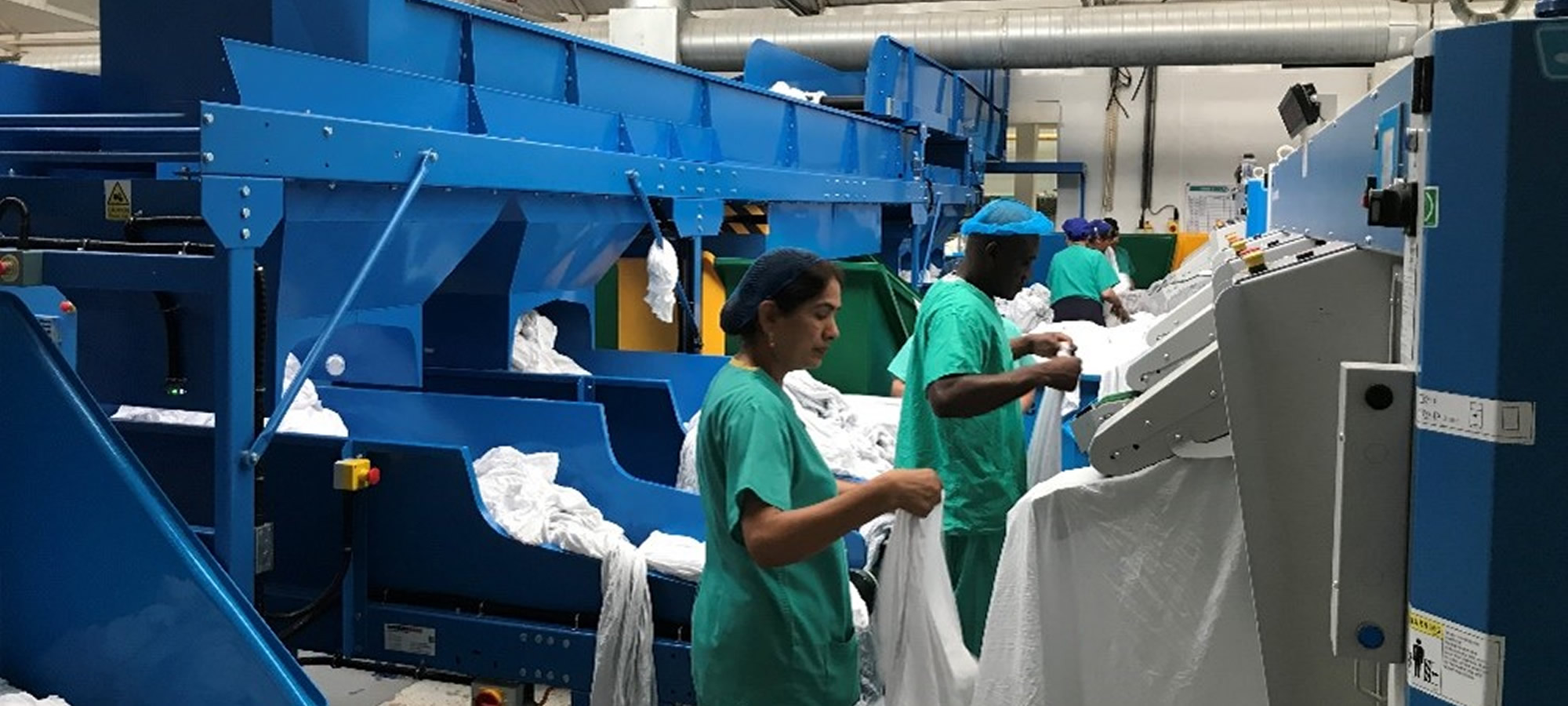
Convoyeurs de blanchisserie
Les blanchisseries industrielles traitent généralement plus de 500 000 articles de linge en vrac par semaine et, pour assurer leur efficacité, l’automatisation est essentielle. Les convoyeurs constituent l’épine dorsale des systèmes de transport automatisés au sein des blanchisseries, acheminant les articles de linge entre les zones de réception du linge sale, les processus de lavage, l’emballage et l’expédition finale au client.
Les applications typiques des convoyeurs dans les blanchisseries comprennent :
- Tri du linge sale
- Convoyeurs à pas indexés pour charger les laveuses CBW avec des charges de 50 à 100 kg
- convoyeurs à gâteaux
- Bandes et plateformes de tri du linge
- Séchoirs, navettes de chargement et convoyeurs à emporter
- courroies d'alimentation et de sortie de la machine à emballer sous film rétractable
De nombreuses blanchisseries sont installées sur des sites anciens dotés d'équipements existants, et l'automatisation se heurte à la difficulté de trouver suffisamment d'espace pour installer des convoyeurs. Tous les convoyeurs Amber sont conçus et fabriqués sur mesure et peuvent donc être adaptés aux exigences du site en modifiant la longueur, la largeur et la hauteur de la bande.
- Lits en acier doux revêtus de poudre avec cantonnières en acier inoxydable ou revêtues de poudre
- surfaces internes lisses
- Surfaces internes sans interstices
- Bords ourlés autour des cantonnières
- courroies continues
- Des protections robustes contre le pincement des doigts sont situées sur le dessus du rouleau.
- Convoyeurs horizontaux préférés immédiatement avant les positions de transfert par chute
- Augmentation de la vitesse du convoyeur lors du transfert d'une bande transporteuse à une autre.
- Aucune charge au-dessus des côtés des cantonnières
- La hauteur de chute entre les convoyeurs ne doit pas être inférieure à la hauteur de la bordure du convoyeur d'alimentation.
Frequently Asked Questions About Laundry Conveyors
Laundry conveyors automate the movement of linen through commercial laundry operations. They can transport linen from dirty linen receiving and sorting areas, through washing, drying, ironing and folding processes, and finally to packing and dispatch.
Typical applications include dirty linen sorting, indexing step conveyors for loading Continuous Batch Washers (CBW), cake conveyors, linen sorting belts and platforms, dryer loading shuttle cars and takeaway conveyors, and shrink wrapper infeed and outfeed belts.
Yes. Many commercial laundries operate on established sites where space is restricted by existing equipment. Amber designs and builds its laundry conveyors for the individual application, allowing dimensions such as belt length, width and height to be tailored to the site.
Belt conveyors can move dirty linen from delivery vehicles to sorting or washing areas. After washing, pressed linen or “cakes” can be conveyed to sorting areas or directly to dryers, while further conveyors can transfer dried linen towards ironing and folding operations.
Amber identifies snagging as a major consideration when conveying loose linen. Internal conveyor surfaces should therefore be smooth, continuous and wherever possible gap-free, with particular attention paid to avoiding narrowing gaps where linen could become trapped or wedged.
Where one conveyor transfers linen onto another, Amber recommends that the takeaway conveyor operates faster than the feed conveyor. This speed differential helps reduce the possibility of linen becoming trapped at the transfer point and is particularly important when transferring from a declined conveyor to a horizontal conveyor.
Small-diameter rollers, such as the 60 mm diameter rollers referenced by Amber, can be used at the head and tail of conveyors to reduce the V-shaped gap between adjoining rollers. This reduces the distance linen must travel when transferring between conveyors and helps reduce trapping.
Tuck-under occurs when linen sticks to the conveyor belt and begins following the return belt underneath the conveyor. Amber advises reducing belt friction where possible so that linen releases more easily. Where this is not possible, a sensor beneath the head roller can be linked to the conveyor emergency-stop system to detect the problem and stop the conveyor.
Depending on the conveyor arrangement and height, protection can include nip guards, full-panel underguards and local roller covers. Amber notes that guarding should provide appropriate protection while taking account of linen snagging, cleaning access, maintenance and the likelihood of operators coming into contact with moving parts.
Yes. Amber provides conveyor systems for moving linen through multiple stages of commercial laundry operations, and complementary materials-handling equipment such as lifts, hoists and shuttle cars can also be incorporated to improve the efficiency of linen movement around the laundry.